Does a Keyword in Your Channel Name Help You Rank?
Somewhere in the first week of building a channel, almost everyone asks the same question: should I put my keyword in the channel name? The advice you find is confident in both directions, and most of it is reasoning backwards from things that look like evidence.
So let me answer it directly, and then spend the rest of this on the more useful question underneath — what the name is genuinely doing for you, which is not nothing.
Where the Belief Comes From
Search a topic on YouTube and you will often see channels whose names contain that exact topic sitting high in the results. The inference is immediate: the keyword in the name put them there.
The trouble is that those channels almost always share three other traits. They publish on that subject constantly, their videos are watched to the end by people who searched that subject, and they have been doing it for years. Any one of those is a better explanation than the name, and you cannot separate them by looking at a results page.
What you are seeing is a correlation between named-for-the-topic channels and topic authority. Which makes sense — people who name a channel after a subject tend to be people who only make videos about that subject.
What Is Actually Documented
There is no published confirmation that keywords in a channel name influence how your videos rank. What the platform does describe, repeatedly and in public, are things like relevance between a query and a video, how satisfied viewers are once they arrive, and what a given viewer has watched before.
The honest position is not “the name has no effect” — nobody outside the platform can prove a negative about a system they cannot see. It is that the effect is unconfirmed, plausibly small, and definitely not the lever people treat it as. Building your channel identity around an unverified ranking theory is an expensive way to place a bet.
Where the Name Genuinely Does Work
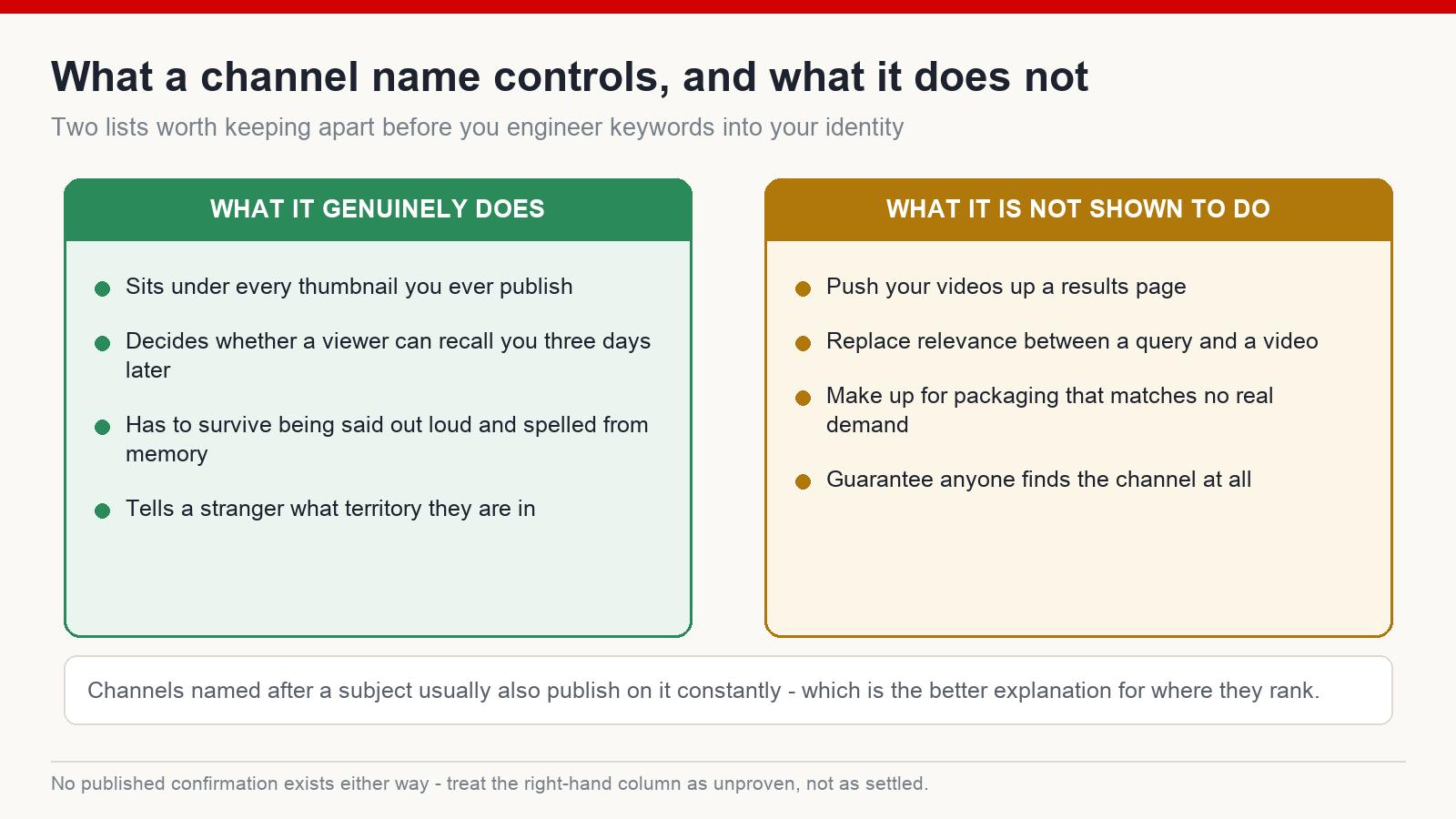
It is the second thing read under every thumbnail. Your videos accumulate impressions, and next to almost all of them sits the channel name. Over a year it is read more times than any individual title you will ever write.
It decides whether people can recall you. Someone watches a video on Tuesday, wants to find you again on Friday, and has to reconstruct your name from memory. Names built from generic topic words are reconstructed wrongly, which sends that viewer to a competitor with a similar name.
It has to survive being spoken. People recommend channels out loud, in comments, in messages. A name that cannot be spelled from hearing it once loses those referrals silently.
It sets an expectation before the click. A name gives a stranger a rough idea of what territory they are in. That is a real benefit — it is just a clarity benefit, not a ranking one.
The Prize Nobody Optimises For
Here is the shift that changed how I think about naming.
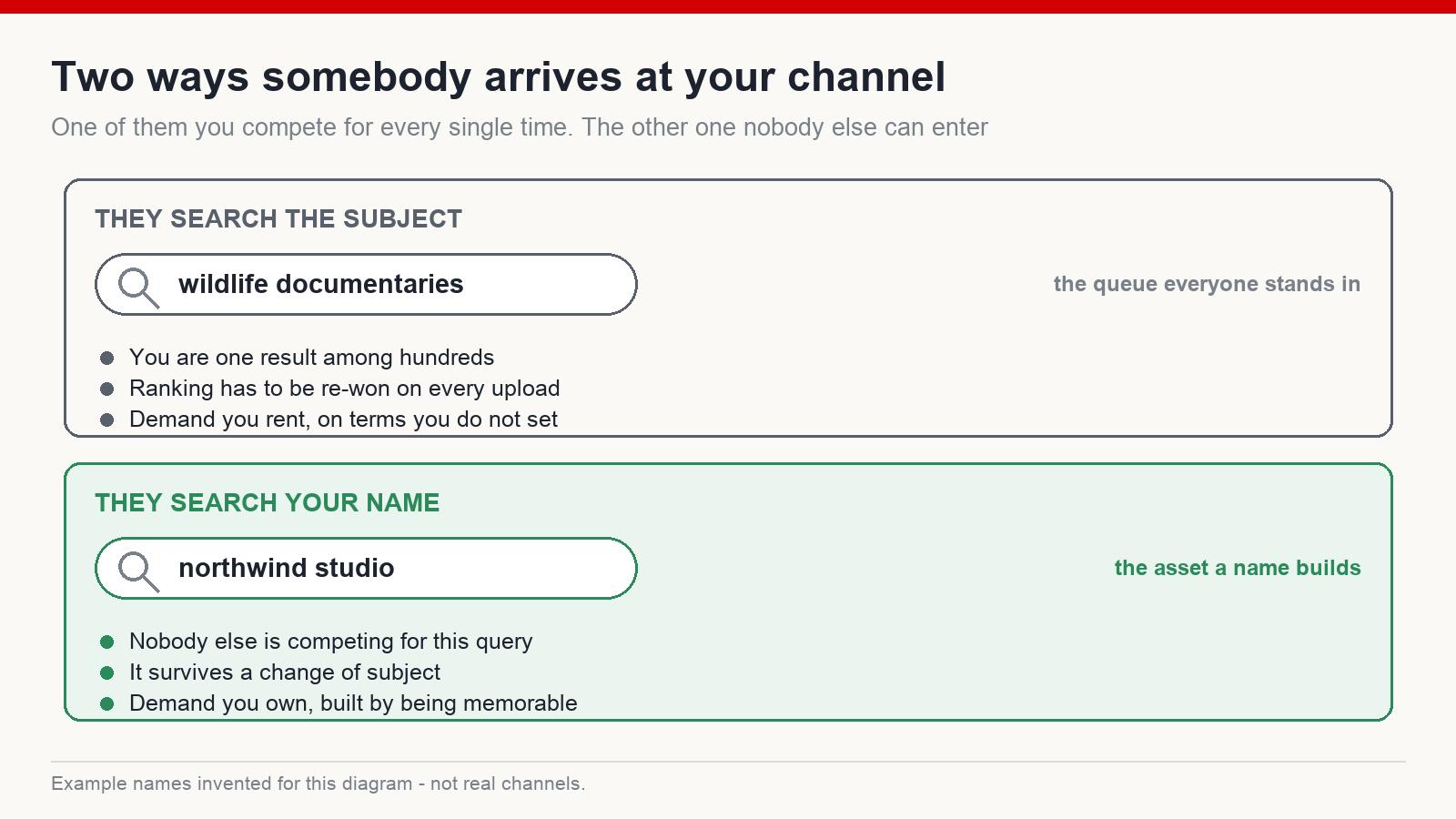
There are two ways someone arrives at your channel. They search the subject — where you compete with everyone who has ever covered it — or they search your name, where you compete with nobody.
The second kind of search is the whole game. It is demand you own rather than rent, it does not fluctuate with what the recommendation system feels like doing this month, and it is the only traffic that survives a change in your subject matter.
A distinctive name accelerates that shift, because it is memorable and typeable. A name built out of the same generic topic words as forty other channels delays it, because there is nothing about it a person can hold onto. Optimising a name for a ranking effect that may not exist, at the cost of the one asset a name definitely builds, is a bad trade.
When a Descriptive Tag Does Earn Its Place
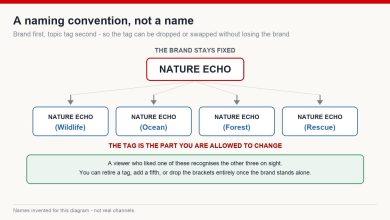
None of this means the name has to be abstract. A short descriptor after a distinctive name — think Northwind Studio · Wildlife rather than Best Wildlife Videos Channel — does useful work for a stranger who has never heard of you and is deciding in half a second whether this is their kind of channel.
The test is who the tag is for. If it is there to tell a human what you make, keep it. If it is there because you believe it improves rankings, you are adding words to your identity in exchange for a benefit nobody has demonstrated.
What the Keyword Costs
Three costs, all of them real and none of them obvious on day one.
You join a crowd. Generic topic words are exactly what everyone else reached for, so your name lands in a cluster of near-identical names and viewers routinely credit your work to someone else in that cluster.
You get longer. Every extra word makes the name harder to say, harder to recall and more likely to be truncated in places where space is short.
You describe your first year rather than your fifth. A name built around the narrow subject you started with becomes a fence when the channel grows, and renaming later costs you the recognition you had accumulated.
Use the Same Name Everywhere
One practical point that matters more than the keyword question: pick the name once and use exactly that string everywhere — channel, handle, other platforms, site if you have one. Same words, same spacing, same capitalisation.
Somebody who heard your name once and is trying to find you elsewhere will type what they remember. Every variation between platforms is a chance for that search to fail.
Where That Effort Is Better Spent
If the hour you were about to spend engineering keywords into your name went instead into finding out what phrases your intended audience actually searches, and building your titles, thumbnails and subject consistency around that, you would be putting the work where the documented signals are.
The name’s job is to be remembered. The packaging’s job is to be found. Asking the name to do the packaging’s job is how people end up with a channel called something nobody can repeat.
The Short Version
- There is no confirmed ranking benefit to keywords in a channel name
- The name’s real jobs are recall, recognition and being spelled correctly from memory
- A short descriptive tag after a distinctive name helps a stranger — that is a clarity choice, not an optimisation
- Branded search is the asset a name builds, and generic names delay it
- Use the identical string across every platform
A memorable name will not rescue weak videos, and no name has ever ranked anything on its own. But over a few hundred uploads the difference between a name people can repeat and a name people approximate is the difference between an audience that can find you and one that keeps almost finding you.
So should I never put a keyword in my channel name?
You can, and plenty of good channels do. Just do it because it tells a viewer what you make, not because you expect it to move your videos up a results page.
Is it too late to change a name built around a keyword?
Not necessarily. Renaming costs you recognition, so it is worth doing while your library is small and worth thinking hard about once people know you. The underlying channel identifier does not change when the display name does.
Does the handle matter as much as the name?
It matters for being found and typed, which is the same job. Keep it as close to the display name as the platform allows and identical to what you use elsewhere.
What actually decides whether my videos get found?
Whether the packaging matches a demand that exists, and whether people who click are satisfied when they arrive. Those two do far more work than anything in the channel name.
If you want the full version of this — naming, niche research and packaging for a channel aimed at an English-speaking audience — that is what I teach at mmoyoutube.com.